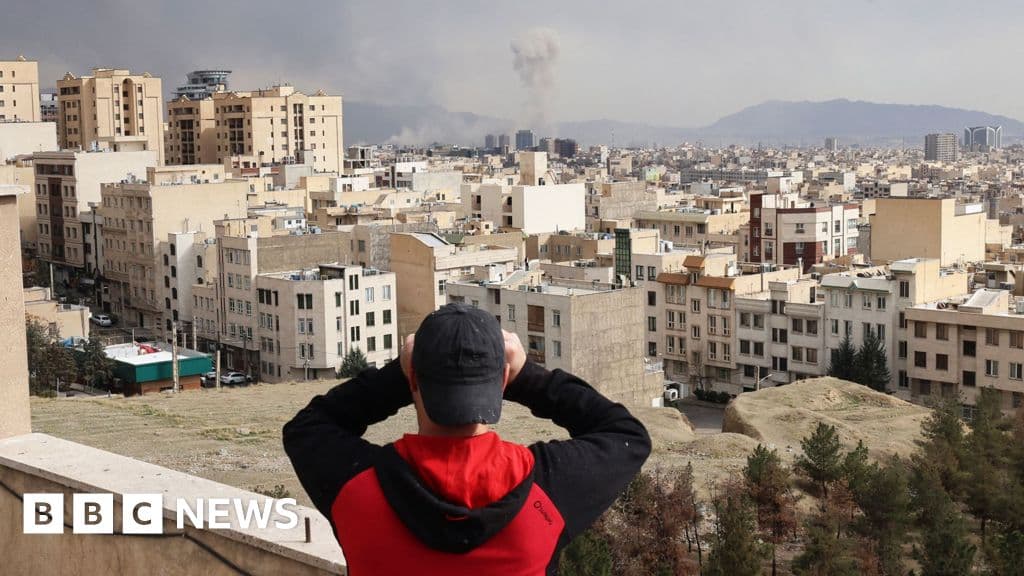
The Middle East is grappling with an unprecedented crisis, following a series of strategic strikes that have profoundly reshaped the regional and global geopolitical landscape.
The geopolitical landscape of the Middle East, a region perpetually at the nexus of global powers, has been irrevocably altered following a dramatic escalation of hostilities. A series of strategic strikes, attributed to the United States and Israel, has initiated an unprecedented chapter, marked by the demise of Iran's Supreme Leader, Ayatollah Ali Khamenei. This event has not merely ignited widespread conflict but has fundamentally recalibrated regional dynamics and sent profound ripples across the international stage.
A New Geopolitical Axis Emerges: The Aftermath of a Defining Strike
The events of a recent Saturday marked a watershed moment. Coordinated strikes by the US and Israel targeted critical Iranian military infrastructure, missile facilities, and high-ranking leadership. The most significant consequence was the flattening of Ayatollah Ali Khamenei's Tehran compound, an act that claimed the life of the leader who had helmed Iran since 1989. This decisive blow also saw the loss of dozens of other senior political and military figures within the Islamic Revolution Guard Corps (IRGC), including the Defence Council secretary and Defence Minister, signaling a deliberate effort to decapitate Iran's strategic command.
The Catalyst: Strikes and Succession
The immediate aftermath inside Iran was one of severe disruption. Internet connectivity was largely curtailed, and airspace was closed, reflecting the gravity of the situation and the regime's efforts to manage information flow. Despite these challenges, Iran swiftly moved to appoint a new commander-in-chief for the IRGC, Ahmad Vahidi, indicating a rapid effort to restore military cohesion. Concurrently, a transitional leadership council, comprising key figures like President Masoud Pezeshkian, was established to govern the nation, signaling a fraught period of political transition amidst external pressures.
Unraveling Regional Stability: Iran's Retaliatory Measures
Iran’s response to these initial strikes was swift and expansive, demonstrating a continued capacity for retaliatory action despite significant losses. Ballistic missiles and drones were launched across a vast expanse of the region, targeting not only Israel but also Gulf states with US military presence, a British base in Cyprus, and crucial shipping lanes.
Escalation Across the Gulf
Cities like Dubai, Doha, and Manama experienced strikes, with Iranian military sources claiming the use of numerous cruise missiles against a US airbase in Kuwait and vessels in the Indian Ocean. Civilian sites, including hotels, were reportedly hit alongside military installations. This widespread targeting of nations not directly involved in the initial strikes drew condemnation from the US and Arab allies, decrying it as reckless and destabilizing behavior.
The Hezbollah Front
Further complicating the volatile situation, Lebanon’s Iran-backed Hezbollah militia group entered the fray, launching rockets into Israel. This opened a new front in the conflict, prompting immediate Israeli counter-strikes in Beirut and southern Lebanon. Hezbollah explicitly stated its actions were in revenge for Khamenei's assassination, underscoring the interconnectedness of regional proxy networks and the potential for a cascading series of retributions.
Global Reverberations: Economy, Trade, and Travel
The far-reaching impact of this Middle East conflict extends beyond the immediate battlegrounds, threatening global economic stability and international logistical networks.
Energy Market Volatility
Perhaps the most immediate and significant global consequence has been the disruption to the critical Gulf energy industry. Attacks on Qatar’s liquefied natural gas production facilities and Saudi Arabia’s Ras Tanura refinery led to partial shutdowns, causing a dramatic surge in global gas and oil prices. The Brent crude benchmark quickly escalated, reflecting market anxieties over supply security. Furthermore, Iran’s explicit warning to vessels not to traverse the Strait of Hormuz, a choke point for approximately 20% of the world’s oil and gas, amplified fears of sustained energy price volatility and supply chain disruptions.
Disrupting Global Connectivities
The conflict has also severely impacted global travel and connectivity. Thousands of flights to and from the region were grounded, leading to one of the most significant disruptions since the pandemic. Major airlines, including Emirates, Virgin Atlantic, and British Airways, either suspended or rerouted flights, while several regional airspaces, including those of Iraq and Jordan, were closed. This logistical upheaval underscores the interconnectedness of global systems and the rapid spillover effects of regional instability.
Strategic Imperatives and an Uncharted Future
Both the US and Israel have articulated their strategic imperatives for the operation, signaling a firm resolve to reshape the regional power balance.
Articulating Objectives
US President Donald Trump stated the operation’s aim was to “ensure that Iran does not obtain a nuclear weapon” and to obliterate its missile industry, urging the Iranian populace to overthrow the clerical establishment. Israeli Prime Minister Benjamin Netanyahu echoed these sentiments, framing the operation as a necessary step to “remove the existential threat posed by the terrorist regime in Iran.” These declarations point towards a strategic goal far beyond mere retaliation, hinting at a fundamental restructuring of Iran’s capabilities and perhaps its governance.
The Durational Question
While the initial phase of strikes was projected to last several weeks, statements from both Trump and Netanyahu suggest a readiness for a prolonged engagement. The US president indicated a capability to sustain operations for an extended period, while the Israeli prime minister affirmed that the campaign would continue “as long as it is needed.” This open-ended commitment points to a protracted period of instability and conflict, with profound implications for the region and for the broader international order. The trajectory of this evolving crisis remains uncertain, yet its impact on geopolitical thought, global resource allocation, and the architecture of international security will undoubtedly be profound and enduring."Architectural silence is often the most profound statement a structure can make. It creates space for the mind to breathe."
— The EverGreen Compendium