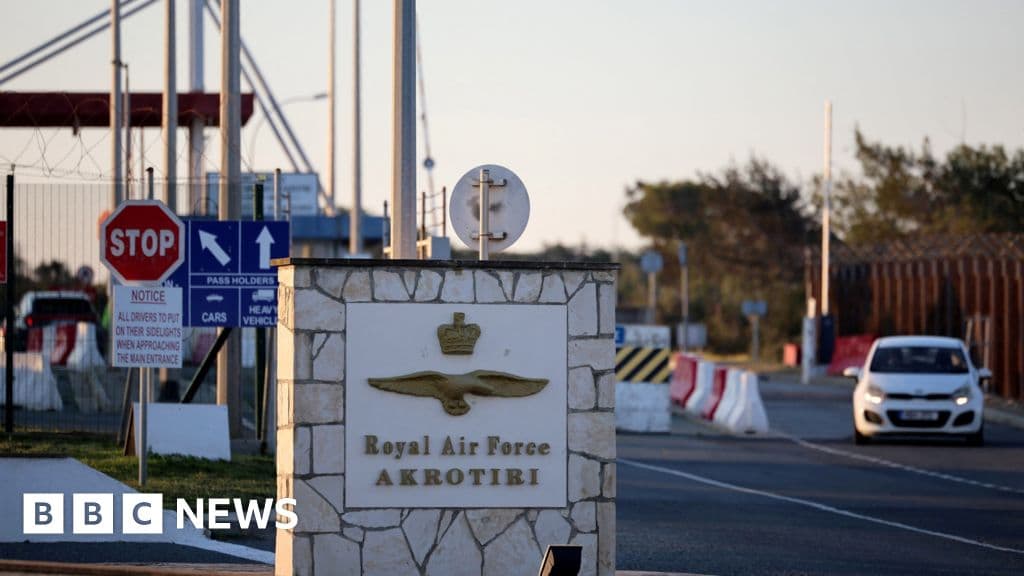
The drone incident at RAF Akrotiri transcends news, offering a profound lens into the intricate architecture of global security and the evolving nature of strategic infrastructure in a volatile world.
The tranquil shores of Cyprus, a historic crossroads of civilizations, recently bore witness to an incident that, while seemingly minor in its immediate impact, reverberates with profound geopolitical significance. The crash of an Iranian-origin drone into the British Royal Air Force (RAF) Akrotiri base on a Sunday evening serves as a stark reminder of the intricate and increasingly volatile architecture of international security.
For EverGreen, a journal dedicated to the intersection of architecture and intellect, this event transcends a mere news report. It compels us to examine the strategic infrastructure that underpins global power dynamics, the evolving nature of modern conflict, and the delicate balance required to maintain stability in an interconnected world.
The Incident's Resonance: A Microcosm of Macro Tensions
President Nikos Christodoulides of Cyprus confirmed the drone's origin, a Shahed unmanned aerial vehicle, crashing within the British Sovereign Base Area. While casualties were thankfully averted and damage to the base deemed “minimal,” the response – including the temporary relocation of non-essential personnel and families – underscores the heightened threat perception. This was not an isolated event but a tangible manifestation of broader regional hostilities, specifically the escalating tensions involving Iran, its allies, and Western interests.
This incident forces us to look beyond the immediate damage, focusing instead on the symbolic impact and the disruption it signals. It highlights the vulnerability of even robust strategic assets to asymmetric threats, pushing the boundaries of traditional defense architectures.
Strategic Architecture Under Scrutiny: RAF Akrotiri's Enduring Role
The Anatomy of a Sovereign Base
RAF Akrotiri is more than just an airfield; it is a critical piece of geopolitical architecture. As one of the United Kingdom's two Sovereign Base Areas in Cyprus, it represents a unique legacy of post-colonial arrangements, granting the UK sovereign territory for military purposes. Architecturally and operationally, these bases are designed as self-contained ecosystems, projecting power and providing logistical support far from the homeland. Akrotiri, strategically positioned in the Eastern Mediterranean, acts as a vital hub for intelligence gathering, surveillance, and rapid deployment across the Middle East and North Africa. Its very existence is a testament to enduring strategic interests and the physical embodiment of international influence.
Modern Threats and Adaptive Defenses
The drone crash at Akrotiri throws into sharp relief the challenges faced by static military installations in an era of dynamic, low-cost, and easily deployable weapons systems. The 'minimal damage' belies the potential for disruption and the psychological impact of such incursions. The Ministry of Defence's swift declaration of “force protection at the highest level” and the relocation of families illustrate a necessary adaptation in military planning – moving beyond purely offensive or defensive capabilities to embrace resilience and protective measures for personnel. This requires a constant reassessment of base design, perimeter security, and air defense systems, evolving to counter threats that transcend traditional warfare paradigms.
Broader Geopolitical Currents: The Evolving Landscape of Conflict
The Akrotiri incident did not occur in a vacuum. It unfolded against a backdrop of intense regional conflict, with the UK having agreed to a US request to utilize British military bases for “defensive” strikes. While the UK, through Prime Minister Sir Keir Starmer, emphasized a non-offensive stance and a learning from past mistakes in Iraq, the interconnectedness of alliances means British assets inevitably become part of the broader strategic calculus.
Statements from figures like EU Commission President Ursula von der Leyen, expressing collective solidarity with member states against threats, underscore the intricate diplomatic architecture at play. UK Foreign Secretary Yvette Cooper's condemnation of Iran's “reckless behavior” further contextualizes the drone crash within a pattern of aggressive actions across the Gulf region. This expanding arena of drone and missile strikes, targeting a spectrum of US assets and allies, paints a picture of a new *architecture of aggression* that demands a unified and adaptive response.
Resilience and the Path Forward: Designing for Stability
The events at RAF Akrotiri serve as a potent case study in contemporary geopolitical architecture. They highlight the need for not just physical fortification but also intellectual resilience in understanding and navigating global complexities.
For architects, urban planners, and strategists, the incident prompts questions about the future design of strategic infrastructure: how can bases be made more resilient to hybrid threats? How can defensive perimeters be extended beyond physical boundaries into the cyber and electromagnetic spectrums? And how do we design international frameworks that foster stability rather than merely reacting to crises?
The crash of an Iranian drone into a British base on Cypriot soil is a microcosm of a larger, evolving global security landscape. It demands an intellectual engagement that moves beyond immediate headlines, delving into the strategic, architectural, and diplomatic structures that will define peace and conflict in the 21st century. The path forward requires a continuous re-evaluation of our collective architectural and intellectual responses to maintain equilibrium in an increasingly fractured world."Architectural silence is often the most profound statement a structure can make. It creates space for the mind to breathe."
— The EverGreen Compendium